
BPH & Prostate Care • Karol Bagh, New Delhi

BPH & Enlarged Prostate Treatment in Delhi

Trouble starting urine, a weak stream, frequent trips to the washroom or waking several times at night can happen when the prostate becomes enlarged. At Govinda Healthcare, Karol Bagh, we evaluate BPH and other non-cancerous prostate problems using your symptoms, urine flow, prostate size and relevant tests. Treatment may include medicines, TURP, HoLEP or laser prostate surgery depending on the findings.

BPH & Enlarged Prostate Weak flow, frequency, nocturia & retention
PSA, Ultrasound & Uroflowmetry Tests advised according to your symptoms
TURP, HoLEP & Laser Surgery Treatment selected according to prostate size and blockage
BPH and enlarged prostate treatment in Delhi by Dr. Vijayant Govinda Gupta

Dr. Vijayant Govinda Gupta

BPH and prostate consultation in Karol Bagh, near Patel Nagar, New Delhi

BPH & Prostate Symptoms

Signs of an Enlarged Prostate You Should Not Ignore

BPH usually develops gradually, so the early changes can be easy to dismiss. A weaker urine stream, taking longer to start urinating, getting up several times at night or feeling that the bladder has not emptied properly are some of the common symptoms of an enlarged prostate. If these problems are becoming frequent, it is worth getting them checked instead of simply adjusting your routine around them.

When urinary symptoms start changing your routine, get them checked

Some men live with urinary problems for months because the changes happen slowly. They plan travel around toilets, avoid drinking water before going out, wake repeatedly at night or push to empty the bladder. These symptoms may be related to BPH, but the cause cannot be confirmed from symptoms alone. A urology assessment helps show whether the prostate is actually causing an obstruction and how severe the problem is.

An enlarged prostate is not the only cause of urinary symptoms. Urinary infection, bladder conditions, urethral stricture and other problems can produce similar complaints, which is why the diagnosis should come before treatment.

Weak or slow urine flow

The stream is noticeably weaker, thinner or slower than it used to be.

Frequent urination at night

Waking two, three or more times at night to pass urine.

Difficulty starting urination

There is a delay before urine starts, even when the bladder feels full.

Bladder does not feel empty

You finish urinating but still feel that some urine is left behind.

Frequent or sudden urge to urinate

You need to urinate more often or sometimes have very little time to hold it.

Straining or stop-start urine flow

You need to push to pass urine, or the stream repeatedly stops and starts.

Urinary symptoms becoming more frequent or disturbing your sleep?

A prostate and urinary evaluation can help determine whether the problem is BPH, an infection, a bladder issue, urethral narrowing or another cause. Patients from Karol Bagh, Patel Nagar and other parts of Delhi can consult at Govinda Healthcare.

Call +91 95929 99184
BPH & Prostate Diagnosis

Tests Used to Check an Enlarged Prostate and Urine Flow

Prostate size alone does not tell the whole story. Some men have a larger prostate but only mild symptoms, while others have significant blockage with a smaller gland. The useful tests are the ones that show how well urine is flowing, whether the bladder is emptying properly and whether there is anything else that needs to be ruled out.

01

Uroflowmetry Test

Uroflowmetry measures the speed and pattern of your urine flow. It is especially useful when the stream has become weak, slow or stop-start. The result can help show whether there may be an obstruction to urine flow due to BPH or another urinary problem.

Commonly used for weak or slow urine flow
02

Prostate Ultrasound & Post-Void Residual

Ultrasound helps assess prostate size and the urinary bladder. A post-void residual check measures how much urine remains in the bladder after urination. If a significant amount is left behind, it can suggest that the bladder is not emptying properly.

Checks prostate size and incomplete bladder emptying
03

Serum PSA Blood Test

PSA is a blood test used as part of prostate evaluation. A raised PSA does not automatically mean cancer. Levels can also change with benign prostate enlargement, inflammation and other prostate conditions. The value is interpreted together with your age, symptoms, examination and other findings.

Used when PSA testing is clinically appropriate

Not every patient needs the same prostate tests

The first step is usually to understand the symptoms properly. Previous prescriptions, urine reports, PSA results, ultrasound, existing medical conditions and current medicines can all affect what should be checked next. Tests such as uroflowmetry, ultrasound, post-void residual or serum PSA are selected according to what needs to be clarified before deciding on BPH treatment.

Already have prostate reports?

Bring your old reports to the consultation

Previous PSA, prostate ultrasound, uroflowmetry, urine test reports or prescriptions can help when reviewing your BPH or enlarged prostate symptoms.

Call +91 95929 99184
BPH Treatment Options

BPH and Enlarged Prostate Treatment in Delhi: Medicines, TURP, HoLEP & Laser Surgery

An enlarged prostate does not automatically mean surgery. Many men with BPH can manage their symptoms with medicines, especially when urine flow is reasonable and the bladder is emptying well. Surgery is more likely to be considered when symptoms remain troublesome, repeated urinary retention occurs, bladder emptying becomes poor or medicines are no longer giving enough relief.

The right BPH treatment depends on how much the prostate is affecting urine flow

Treatment is not chosen from prostate size alone. A man with a large prostate may have manageable symptoms, while a smaller gland can sometimes cause significant blockage. Urine flow, residual urine in the bladder, repeated retention, infections, kidney or bladder effects, age, current medicines and general health all matter when deciding between medical treatment and surgery.

BPH is a benign, non-cancerous enlargement of the prostate. The aim of treatment is to relieve obstruction, improve urine flow and help the bladder empty more effectively — not simply to reduce prostate size on a scan.
01

Medicines for BPH

Medicines are often the first treatment for mild to moderate BPH symptoms. Depending on the case, they may help relax the prostate and bladder neck to improve urine flow, or gradually reduce prostate volume. The choice depends on symptoms, prostate size, blood pressure and other medicines you are already taking.

02

TURP Surgery for Enlarged Prostate

TURP removes the prostate tissue that is blocking the urine passage. The procedure is performed through the urethra, so there is no external surgical cut. It remains a commonly used option for men with significant BPH symptoms or urinary obstruction.

Learn about TURP Surgery in Delhi
03

HoLEP and Laser Prostate Surgery

Laser procedures such as HoLEP may be considered when surgery is needed for BPH. The most suitable procedure depends on prostate size, the degree of urinary blockage, bleeding risk, medicines, previous retention and the surgeon's assessment. TURP, HoLEP and other laser techniques are not interchangeable in every patient.

Compare TURP & Laser
BPH & Prostate Video Library

BPH & Enlarged Prostate Videos by Dr. Vijayant Govinda Gupta

Watch practical videos about enlarged prostate symptoms, weak urine flow, frequent night urination, PSA testing, BPH medicines, urinary retention, TURP, laser prostate surgery and recovery. These videos can help you understand the problem before your consultation.

BPH Surgery

When Is Surgery Needed for an Enlarged Prostate?

Many men with BPH can continue on medicines for years without needing an operation. Surgery is usually discussed when the prostate is causing persistent urinary obstruction, the bladder is no longer emptying well, retention keeps coming back or symptoms continue to interfere with normal life despite treatment.

A large amount of urine remains in the bladder

If the bladder repeatedly fails to empty properly after urination, the obstruction may need more than medicines alone.

Repeated urinary retention or catheter use

If urine has stopped completely on more than one occasion, or a catheter is repeatedly needed to empty the bladder, the prostate blockage should be assessed for surgery.

BPH medicines are no longer controlling the symptoms

A weak stream, frequent urination, repeated night-time urination or straining may continue even after regular medical treatment.

Repeated infection, bladder stones or other complications

Long-standing poor bladder emptying can sometimes contribute to recurrent urinary infection, bladder stones and other problems that need more active treatment.

TURP, HoLEP and laser prostate surgery are done through the urinary passage

These procedures are performed through the urethra, so there is generally no external abdominal cut. The choice between TURP, HoLEP or another laser technique depends on prostate size, the degree of blockage, bleeding risk, medicines, previous retention and the findings during the urology evaluation.

The operation should match the problem. The goal of BPH surgery is to remove the tissue causing the obstruction and improve urine flow. A more extensive procedure is not automatically a better procedure for every patient.
Karol Bagh • Central Delhi

BPH & Prostate Treatment in Karol Bagh, Delhi

If a weak urine stream, frequent urination, repeated night-time urination or difficulty emptying the bladder has started affecting your routine, it is better to find out what is causing the problem instead of simply continuing medicines without review.

At Govinda Healthcare in Karol Bagh, patients with BPH and enlarged prostate symptoms are assessed using their current complaints, previous treatment and available reports. PSA, prostate ultrasound, post-void residual and uroflowmetry may be reviewed when relevant. The next step may be observation, medicines or a procedure such as TURP, HoLEP or laser prostate surgery depending on the findings.

Karol Bagh, New Delhi

Convenient for patients from Karol Bagh, Patel Nagar and nearby Central Delhi

Prostate tests reviewed together

PSA, ultrasound, PVR and uroflowmetry when clinically relevant

BPH medicines when appropriate

Not every enlarged prostate needs an operation

TURP, HoLEP & laser options

Endoscopic prostate surgery when the blockage requires treatment
Book a prostate consultation: +91 95929 99184
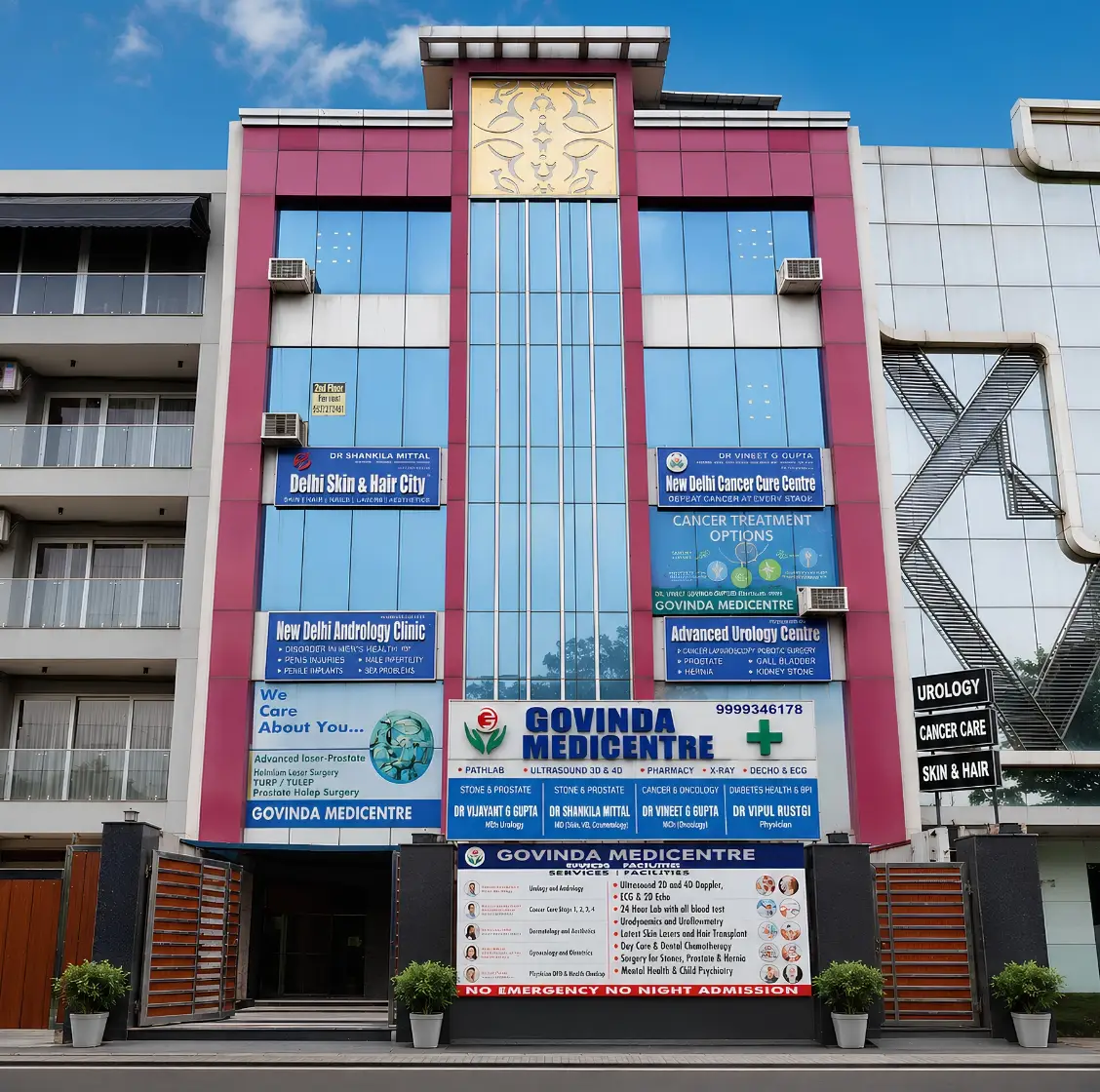
Govinda Healthcare clinic for BPH and prostate treatment in Karol Bagh Delhi
Karol Bagh, New Delhi

Govinda Healthcare

Consultation for BPH, enlarged prostate and urinary symptoms in Karol Bagh, with access for patients coming from Patel Nagar and nearby areas of Delhi.

BPH & Prostate FAQs

Common Questions About BPH and Enlarged Prostate Treatment

Men with an enlarged prostate often have similar questions about medicines, PSA, urine flow tests, TURP, HoLEP and laser surgery. The right treatment still depends on the symptoms, prostate size, bladder emptying and the findings on evaluation.

Does a large prostate always need surgery?

No. Prostate size alone does not decide whether surgery is needed. Some men with a large prostate have mild symptoms and good urine flow, while a smaller prostate can sometimes cause significant blockage. Symptoms, uroflowmetry, bladder emptying and previous urinary retention are considered together.

Can BPH be treated without surgery?

Yes. Many men with mild or moderate BPH symptoms can be managed with medicines. The choice of medicine depends on the urinary symptoms, prostate size, other health conditions and medicines already being taken. Surgery is generally considered when symptoms or obstruction are no longer adequately controlled.

Is BPH the same as prostate cancer?

No. BPH means benign prostatic hyperplasia, which is a non-cancerous enlargement of the prostate. BPH and prostate cancer are different conditions, although some urinary symptoms can overlap. That is why prostate symptoms are evaluated rather than diagnosed from symptoms alone.

What does a Serum PSA test show?

PSA is a blood test related to the prostate. A raised PSA value does not by itself mean prostate cancer. PSA can also change with benign prostate enlargement, inflammation and other prostate conditions. The result needs to be interpreted with age, symptoms, examination and other findings.

Why is uroflowmetry done for enlarged prostate symptoms?

Uroflowmetry measures the speed and pattern of urine flow. It can help show whether the stream is weak or obstructed. It is often considered along with prostate size and post-void residual urine when assessing BPH symptoms.

What is the difference between TURP and HoLEP?

Both TURP and HoLEP are endoscopic procedures used to relieve urinary obstruction caused by prostate tissue. TURP removes obstructing tissue using a resection technique, while HoLEP uses a holmium laser. Which procedure is considered depends on prostate size, medical history, bleeding risk and the surgeon's assessment.

Is laser prostate surgery done without an external cut?

Procedures such as HoLEP and other endoscopic prostate operations are generally performed through the urinary passage using an endoscope. They do not usually require an external abdominal incision.

When is surgery usually considered for BPH?

Surgery may be discussed when medicines are no longer providing enough relief, urine repeatedly gets blocked, the bladder is not emptying properly, a catheter is repeatedly needed or complications such as recurrent infection or bladder stones develop.

Why is a catheter needed in some prostate patients?

A catheter may be required when a patient cannot pass urine and the bladder needs to be drained. A catheter can also be used for a short period after some prostate procedures while the urinary passage recovers.

Can BPH medicines affect sexual function?

Some prostate medicines can affect ejaculation, libido or sexual function in certain patients. If this happens, discuss it with the treating doctor rather than stopping or changing the medicine on your own.

Is frequent urination always caused by an enlarged prostate?

No. Frequent urination can also occur with urinary infection, bladder conditions, diabetes, increased fluid intake and other problems. The symptoms need to be evaluated before assuming that BPH is the only cause.

When should I see a urologist for prostate symptoms?

Consider an evaluation if the urine stream is becoming weaker, urination takes longer, you are waking repeatedly at night, there is frequent urgency or you regularly feel that the bladder has not emptied completely.

Before Your Prostate Consultation

What Should You Bring for a BPH or Enlarged Prostate Consultation?

You usually do not need to repeat every prostate test before your appointment. If you already have reports, prescriptions or details of previous treatment, bring them with you. Seeing what has already been checked can make it easier to understand how your urinary symptoms have changed and what, if anything, needs to be investigated next.

Previous prostate reports

Bring PSA, ultrasound, post-void residual, uroflowmetry or urine test reports if you already have them.

Current BPH medicines

Bring the prescription, medicine strips or a clear photo of the medicines you are currently taking.

Note your urinary symptoms

Think about weak flow, frequency, urgency, night-time urination, straining and whether the bladder feels completely empty.

Catheter or prostate surgery history

Mention any previous urinary retention, catheterisation, TURP, laser surgery or other urinary procedure.

Govinda Healthcare • Karol Bagh

Need a consultation for BPH or urinary symptoms?

You can call the clinic to book an appointment or send your existing PSA, ultrasound, uroflowmetry and other prostate reports on WhatsApp before your visit.

Govinda Healthcare · Karol Bagh, New Delhi · Convenient for patients coming from Patel Nagar and nearby areas
Visit Govinda Healthcare

Find us in Karol Bagh, New Delhi

Visit Govinda Healthcare for urology and prostate consultation. Use the map below for directions to the clinic.

Get Directions

Govinda Healthcare

Karol Bagh, New Delhi

+91 95929 99184
Scroll to Top